

Handwoven Shui Tea Mat / Table Runner (Plant-Dyed Cotton Textile)
- Regular price
-
£40.00 - Regular price
-
- Sale price
-
£40.00
Tax included.
Shipping calculated at checkout.
Handwoven Shui Tea Mat / Table Runner (Plant-Dyed Cotton Textile)
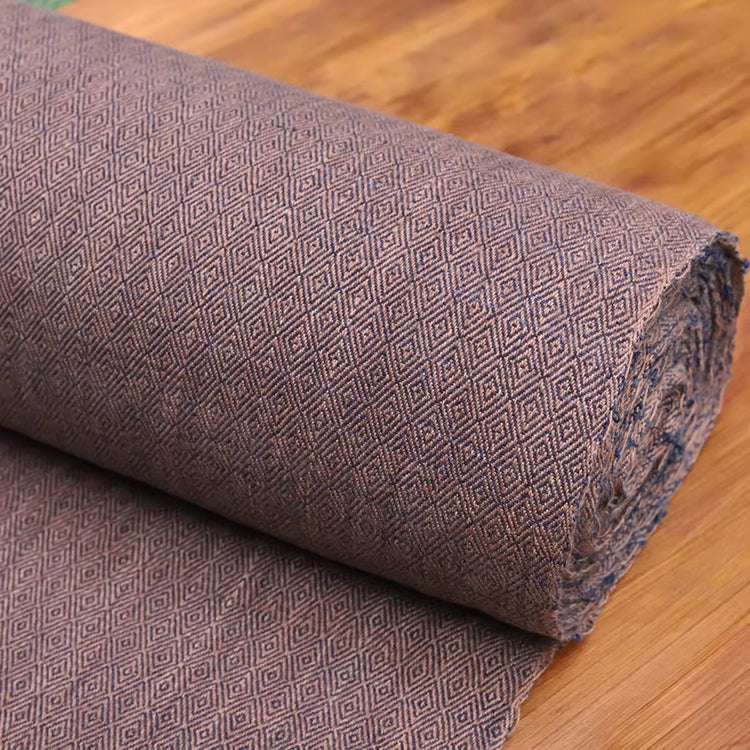
A handwoven tea mat and table runner textile from the Shui people of Guizhou, made from plant-dyed cotton through generations of weaving tradition. Each piece carries the quiet rhythm of plant, hand, and time.
This textile, like a living scripture, carries a way of life that has remained largely unchanged.
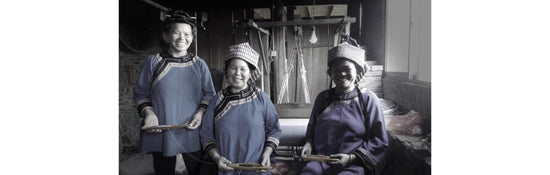
Among the Shui (Water) people and many other indigenous groups in Guizhou, this handwoven tea mat and table runner textile carries a living quality: it is grown, prepared, and guided through a full cycle of life. Shui women have long carried this responsibility, undertaking every step from planting cotton to making cloth, and are deeply valued for their strength and endurance. They are among the few who still preserve a complete textile tradition — not separated as “craft” or “art,”but one that remains part of daily life, sustained by the steady hands and memory of women across generations.
The textile here follows such generational knowledge: Cotton is planted, picked, loosened, and spun into thread. The fibres are strengthened with plant starch, then carefully arranged on the loom before a single line is woven. The subtle diamond pattern emerges through this rhythm, line by line, as the shuttle passes back and forth.
For the Shui people, the diamond pattern is seen as the “eye of the ancestors”, which watches over and protects, offering blessings to the continuity between those who came before and those who come after.
The colour carries the depth of plant-dyeing traditions, where natural pigments are extracted, fermented, and layered over time. In some techniques, soybean paste is used as a resist, allowing patterns to appear through absence rather than addition.
Each cloth is woven and finished entirely by hand. Slight variations in tone, width, and texture are not imperfections, but traces of the process itself.
This cloth can sit beneath your teaware, softening the sound of each placement and holding the warmth of every pour. It can rest across a table, a desk, or the edge of a bed, or be placed over a sofa, shaped into a cushion, or framed quietly on a wall. Over time, the cloth will soften, respond to light and use, and begin to hold traces of your own rhythm alongside those it already carries.
As the diamond pattern sits quietly within each meter of the fabric, may it bring a sense of watchfulness and care to your home.
Details
Craft: Traditional Shui hand-weaving
Material: Handwoven cotton
Dye: Plant-dyed (indigo-based traditions)
Length: This cloth is offered by the metre. You are welcome to choose a length that fits your table, tea space, or home.
- Quantity “1” = 1 metre
- Multiple units will be sent as one continuous length
Width: 38–43 cm
Origin: Guizhou, China
Uses
Tea mat or table runner for Gong Fu Cha or tea rituals
Protective layer for teaware
Plant-dyed, beyond-organic cotton friendly for daily use
Textile accent for the home (bedding, wall, tray, or cushion)
Couldn't load pickup availability
Dimensions
Habitat
Cultural Significance